

Ergonomic Chair, Pelvic Floor Muscles and Sexual Function: What Seated Posture Can Really Change
Current scientific evidence supports a documented connection between seated posture, pelvic mobility, pelvic floor muscle activation and certain dimensions of sexual function in both men and women.
An ergonomic office chair such as the HÅG Capisco, which encourages postural variation, hip opening and more active sitting, can help reduce static sitting and create, all else being equal, more favorable conditions for pelvic mobility and long-term engagement of the pelvic floor muscles.
This does not mean that a chair directly improves sexual performance. It means that the way we sit every day can influence the biomechanical environment around the pelvis, hips, core and pelvic floor.
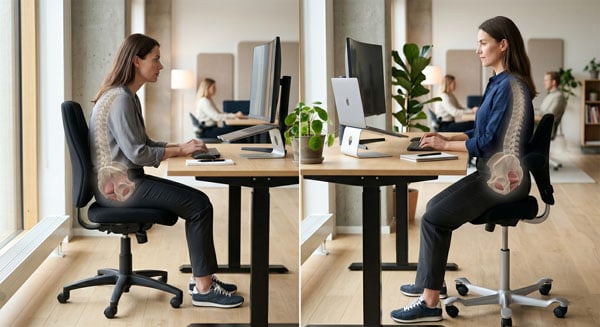
What is the link between seated posture, pelvic floor muscles and sexual function?
The pelvic floor muscles are not only involved in urinary control or pelvic stability. They also contribute to posture, trunk support, pelvic control, hip mechanics and certain functions related to sexual health.
This is why prolonged sitting deserves more attention. When a person sits for long periods in a collapsed or slouched posture, the pelvis often tilts backward, the trunk becomes less active and natural pelvic movement is reduced.
By contrast, a more upright and active seated posture can support better muscular engagement, improved pelvic positioning and greater freedom of movement.
Why pelvic floor muscles matter for both men and women
Pelvic health is often associated with women, especially after pregnancy or childbirth. However, men also have a pelvic floor, and these muscles play an important role in stability, muscular control, pelvic comfort and certain dimensions of sexual function.
An ergonomic chair does not replace targeted pelvic floor exercises, medical treatment or professional care. However, a chair that encourages pelvic mobility, hip opening and micro-movements can contribute to healthier postural conditions throughout the workday.
For people who spend many hours at a desk, the issue is not only how they sit once. It is how often that posture is repeated, day after day.
How slouched sitting can reduce muscle activation
Research has shown that pelvic floor muscle activity can be significantly lower in a slouched sitting posture than in an upright or very upright posture.
In practical terms, the way a person sits can influence how much the pelvic floor muscles participate. This is especially relevant in office work, where many people spend hours in chairs that do not encourage postural variation, pelvic movement or active sitting.
A conventional chair may feel comfortable at first, but if it encourages the user to sink into one fixed position, it can contribute to passive sitting habits over time.
Why most office chairs are part of the problem
A conventional office chair often promotes static sitting, with the pelvis tilted backward and the body held in a fixed position. From a biomechanical standpoint, this limits postural variation and reduces the natural participation of the core muscles, including the pelvic floor.
Available studies show that posture influences muscle activation. They do not prove that one specific chair directly causes pelvic dysfunction or sexual dysfunction.
The broader issue is that most office chairs on the market are designed around support and comfort, but not necessarily around movement, pelvic mobility or active postural engagement.
In that sense, many traditional office chairs are part of a sedentary sitting problem. They may support the body, but they often do little to encourage movement.
What makes the HÅG Capisco different for the pelvis and hips
The HÅG Capisco ergonomic chair differs from conventional office chairs because it is designed around active sitting.
Its saddle seat naturally encourages a more open hip angle, greater pelvic mobility and more frequent changes in position. Instead of locking the user into a single seated posture, the Capisco invites movement.
Users can sit forward, sideways, backward or at a higher semi-standing position when paired with a sit-stand desk. This makes the chair particularly relevant for people who want to reduce static sitting, open the hips, encourage pelvic movement and maintain a more engaged posture throughout the day.
Does the HÅG Capisco directly improve sexuality?
No reliable clinical study demonstrates that an office chair directly improves sexuality, sexual function or sexual performance.
However, all else being equal, the HÅG Capisco chair supports more favorable postural conditions than most conventional office chairs. It encourages active sitting, hip opening, pelvic mobility, postural variation and muscular engagement.
These elements are directly related to pelvic health, which is itself associated with certain dimensions of sexual function.
The accurate statement is therefore not that the Capisco directly improves sexuality. A more precise and responsible statement is that the Capisco helps create a healthier postural environment for the pelvic floor muscles and pelvic mobility, two important components of long-term pelvic health.
Pelvic health at work: why consistency matters
The real issue is not the posture a person adopts for a few minutes. The real issue is repetition.
Many professionals spend six, seven, eight or more hours per day sitting at a desk. Over time, a static and collapsed sitting posture can become the default position of the body.
An active ergonomic chair such as the HÅG Capisco acts precisely at this level. It does not force movement, but it makes movement more natural. It reduces the tendency to remain immobile in a slouched posture and encourages a more dynamic, mobile and engaged way of sitting.
How to choose an ergonomic chair that supports pelvic mobility
To choose an ergonomic chair that supports the pelvic floor muscles and pelvic health, it is important to look beyond simple comfort.
A good ergonomic chair should encourage movement, allow frequent posture changes, support a more upright sitting position and promote hip opening.
The most important criteria include:
- postural variation;
- pelvic mobility;
- hip opening;
- natural core engagement;
- compatibility with a sit-stand desk;
- adjustability for the user’s body type.
From this perspective, the HÅG Capisco is one of the few ergonomic office chairs that genuinely meets these criteria.
Comparison table: conventional office chair vs HÅG Capisco
| Criteria | Conventional Office Chair | HÅG Capisco |
|---|---|---|
| Postural variation | Often limited | Strongly encouraged |
| Pelvic mobility | Often reduced | Encouraged |
| Hip opening | Limited | Supported by the saddle seat |
| Active sitting | Rare | Central to the design |
| Sit-stand desk compatibility | Variable | Highly suitable |
| Core engagement | Often low | More natural |
| Reduction of static sitting | Limited | Encouraged throughout the day |
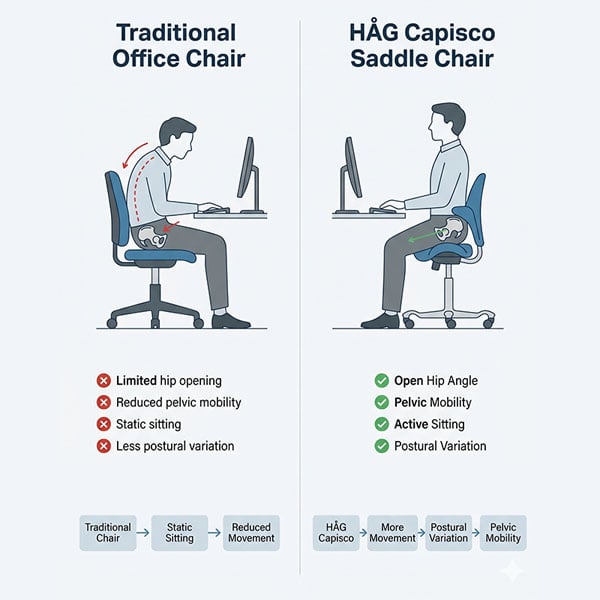
Important scientific note
Current scientific evidence supports a documented relationship between posture, pelvic mobility, pelvic floor function and certain dimensions of sexual function. It does not demonstrate that any chair, including the HÅG Capisco, directly improves sexual function.
The proposed connection is based on a biomechanical mechanism: all else being equal, an active ergonomic chair that encourages postural variation, hip opening and pelvic mobility can reduce static sitting and create more favorable conditions for long-term pelvic floor muscle engagement.
FAQ
Can an ergonomic chair improve sexual function?
No study demonstrates that an ergonomic chair directly improves sexual function. However, a chair that promotes better seated posture, pelvic mobility and pelvic floor muscle engagement can create more favorable conditions for pelvic health.
Is the HÅG Capisco good for pelvic floor muscles?
The HÅG Capisco does not replace pelvic floor exercises or professional care. However, all else being equal, it encourages active sitting, hip opening, posture changes and pelvic mobility, which can support better muscular engagement than a static office chair.
Why does seated posture influence the pelvic floor muscles?
The pelvis, hips, trunk and pelvic floor muscles work together. A slouched posture generally reduces postural engagement, while a more upright and active posture can support greater muscular participation.
Do men also have important pelvic floor muscles?
Yes. The pelvic floor muscles play an important role in stability, muscular control, pelvic comfort and certain dimensions of sexual function in both men and women.
Is the Capisco better than a conventional office chair for pelvic health?
All else being equal, yes, because it encourages more posture changes, hip opening, pelvic mobility and active sitting. It therefore creates more favorable conditions for pelvic health than a conventional chair used in a static way.
References
- Sapsford RR, Richardson CA, Maher CF, Hodges PW. Sitting posture affects pelvic floor muscle activity in parous women. Australian Journal of Physiotherapy. 2006. PubMed PMID: 16942457.
- Sapsford RR, Hodges PW, Richardson CA, et al. Pelvic floor muscle activity in different sitting postures in continent and incontinent women. Archives of Physical Medicine and Rehabilitation. 2008. PubMed PMID: 18760158.
- Jorasz K, et al. Posture Correction Therapy and Pelvic Floor Muscle Function Assessed by Surface Electromyography in Women With Urinary Incontinence. 2022. PubMed PMID: 36612691.
- Jorge CH, et al. Pelvic floor muscle training as treatment for female sexual dysfunction: a systematic review and meta-analysis. 2024. PubMed PMID: 38191016.
- Hwang UJ, et al. Pelvic Floor Muscle Parameters Affect Sexual Function After 8 Weeks of Transcutaneous Electrical Stimulation in Women with Stress Urinary Incontinence. 2019. PubMed PMID: 31563553.
- Sartori DVB, et al. Pelvic floor muscle strength is correlated with sexual function. 2021. PubMed PMID: 33258326.
- Myers C, et al. Pelvic floor muscle training improves erectile dysfunction and premature ejaculation: a systematic review. 2019. PubMed PMID: 30979506.
- Wong C, et al. A systematic review of pelvic floor muscle training for erectile dysfunction and premature ejaculation. 2020. PubMed PMID: 32029399.
- Dorey G, et al. Pelvic floor exercises for erectile dysfunction. 2005. PubMed PMID: 16104916.
- Lavoisier P, et al. Pelvic-floor muscle rehabilitation in erectile dysfunction and premature ejaculation. 2014. PubMed PMID: 25082919.
- Flokk. HÅG Capisco 8106 Product Page.
- Flokk. Official HÅG Brand Page.

